Web Push vs In-Page Push: Which Traffic Drives Better ROI
If you have ever watched a push notification slide onto a screen, you already know how fast a decision gets made. The decision is not really about the offer; it is about whether the title earns a glance before the thumb moves. Buying push traffic means buying a slice of that split-second attention, and the cost per click, the quality of the audience and the way the message renders on the device together decide whether the spend returns a profit. The parent analysis made the same point: a cheap click is not automatically a cheap outcome. Choosing the right format is the first lever a buyer controls, and it is worth getting right before the budget moves. FroggyAds publishes push starting bids from $0.003 per click across 750+ SSP sources, which makes testing inexpensive, but the bid screen alone says little about what a converting visit will cost. The format decision, web push or in-page push, sits underneath every other choice, so this article works through it in practical terms.
What You Need Before Buying Push Ads Traffic
Before any money leaves the account, the offer and the landing page have to be ready to receive a visitor who arrived in a fraction of a second. The page should load quickly on mobile, present a single clear action and match the promise made in the notification title. A visitor who taps a message about a specific offer and lands on a generic homepage will leave, and that bounce will be recorded as a poor click rather than a poor page. Verify the page on a mid-range phone over a slow connection, because that is closer to the real audience than a desktop preview. Many publishers and affiliates route their push ads traffic through a single landing page, which makes it easy to compare how each notification title translates into actual visits.
Both formats can be profitable, and both can waste money when judged by the wrong number
Tracking must be set up before the first impression, not after the first disappointing report. Define the conversion event you will judge the campaign by, whether that is a lead, a registration or a sale, and confirm that the postback or server-to-server call fires with the click identifier attached. Without that link, you can see that clicks happened but not which source, creative or browser produced the outcome you are paying for. A useful rule is to run a test conversion through the full path and check that it appears in the network's reporting with the correct sub-identifiers.
The creative set should contain at least three to five title and image variants, because a single message gives you no basis for comparison. Each title needs to fit the length the operating system and browser will actually display, and the decisive word should not sit at the end of a long line where it gets cut. Budget and stop-loss rules belong on paper as well: a daily cap that limits exposure during the learning phase, and a threshold above which you pause a segment without debate. Finally, check the margin arithmetic. With a given CPC, an expected conversion rate and a payout, the campaign has to show a positive return on paper before launch; if it does not, no amount of optimisation will rescue it.
How Web Push and In-Page Push Actually Differ
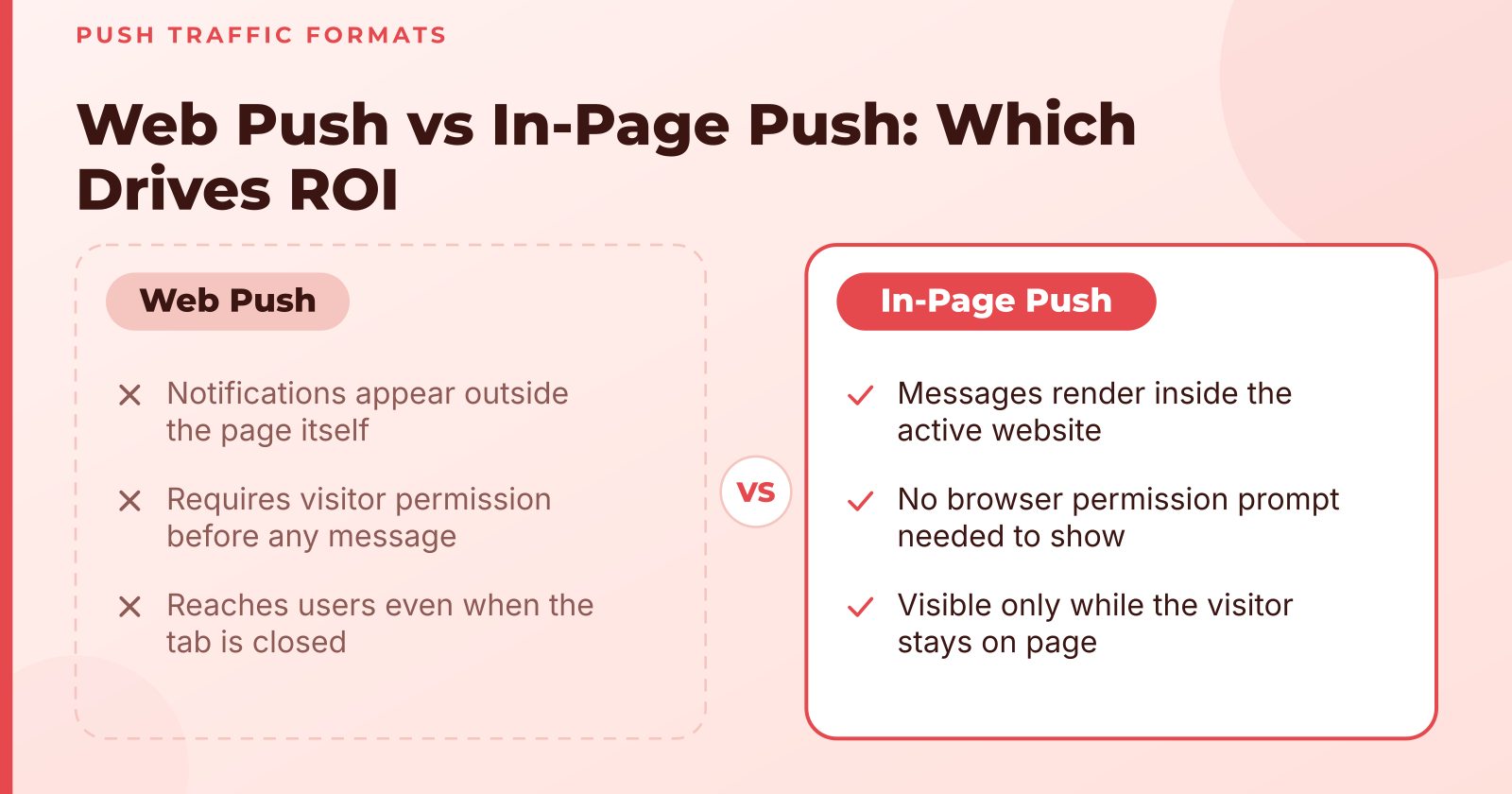
Web push depends on the browser's notification system. A visitor accepts a permission prompt, and afterwards messages can appear outside the page, sometimes even when the browser tab is closed, provided the browser and operating system allow it. Reach is therefore tied to the size and quality of the subscriber base, which is built over time and can be lost when visitors revoke permission. The audience is effectively a list of people who have said yes to receiving notifications, and that list is only as good as the sourcing behind it.
In-page push works from a different premise. The unit is rendered inside a page the visitor is already viewing, in a layout that imitates a notification, and it exists only for the length of that session. No browser permission is involved, so reach is not limited by an opt-in rate; it is limited by the traffic the page receives and by how much of that traffic the unit can occupy without annoying it. The volume is session-bound, which means each impression is tied to a specific moment of browsing rather than to a standing subscription.
The difference shows up in three places that matter for a buyer. The first is reach against attention: web push offers a recurring channel to people who have opted in, while in-page push offers a larger pool of moments with lower prior commitment. The second is opt-in dependency: web push volume is affected by how the publisher collects permissions, whereas in-page volume follows page traffic. The third is rendering: notification titles and icons are displayed according to operating system and browser rules, and in-page units follow the layout of the host page, so a message that reads well in one environment may be clipped in another. Each of these constraints changes what a good creative looks like, which is why the two formats should not share a single set of assumptions.
Step-by-Step Launch Sequence
Start narrow. One geography and one device type reduce the number of variables you have to explain when results come in. If the offer converts on Android in one country, you will know whether a later result is about the creative or about the audience. Broad launches across many geos mix signals so thoroughly that the first week produces numbers nobody can act on with confidence.
Next, run a small pilot split. If the network supports it, put the same creative into both formats so that you can compare how each one treats the message. Keep the bid high enough to earn a readable number of impressions within the first few hours, but not so high that the test spends its budget on the first few minutes of delivery. A pilot that never accumulates impressions tells you nothing, and one that exhausts the cap before the evening traffic arrives tells you only about the morning audience.
Rotate creatives on a fixed schedule and pause the weakest variants before they consume a meaningful share of the budget. Move to a new geo or device only after the first format shows stable conversion across several days, not after a single good afternoon. Expanding early because one number looked strong is the most common way a small winning test turns into a large losing campaign. Before scaling any campaign, it helps to understand How it works on the platform so that you can set frequency caps, targeting rules and budgets in a way that matches your offer.
Metrics to Watch in the First Test Cycle
Click-through rate on impressions tells you whether the title and image earned attention, but it does not tell you whether the visit was worth buying. Track it separately from click-through to the landing page, because a gap between the two often reveals a redirect delay, a broken tracker or a page that loads too slowly for the visitor's patience. Landing page drop-off and the time to the first interaction show whether the promise of the notification survived the trip.
Conversion rate per click is the figure that justifies the spend, and it should not be judged until the conversion count is large enough to carry some weight. A handful of sales on a few hundred clicks can swing wildly in either direction, so set a minimum conversion count in advance and refuse to decide before reaching it. Cost per acquisition then has to be compared with payout, after the share of invalid or fraudulent traffic reported by the network has been removed from the cost side.
Frequency and fatigue matter most for web push, because subscribers who see the same offer repeatedly tend to ignore it or revoke permission. Watch for a falling click rate on the same segment over successive days, and for a rise in unsubscribe signals. Finally, break every result down by browser, operating system and geo. Aggregate numbers hide the segment that is quietly losing money, and that segment is usually the one to cut first.
Checklist: Criteria for Choosing a Format
- The offer fits a short message that can be understood at a glance, which favours push over longer ad formats.
- The goal is mass reach with recurring sends to an opted-in audience, which points to web push.
- The goal is attention at the moment of browsing on a specific site, which points to in-page push.
- The budget can absorb a learning phase long enough to produce several hundred conversions' worth of data, or the test should be scaled down to a narrower question.
- The network reports source, placement and invalid-traffic figures transparently enough to diagnose a problem.
- Tracking and postbacks have been verified end to end before any scaling decision is made.
Common Mistakes and How to Avoid Them
Judging a format on click-through rate alone is the error that does the most damage. A title that produces a high click rate can attract curious visitors who never intend to buy, and the campaign looks healthy on the dashboard while the payout never arrives. Always read the click figure beside the conversion and the cost of the conversion, and let the post-click numbers have the final word.
Ending a test too early is the second error. Stopping after a day, because the first numbers are either very good or very bad, mistakes noise for a pattern. Decide the minimum sample and the stop-loss in advance, then hold to them even when the dashboard is tempting you in either direction.
Mixing formats and geos inside one campaign makes results impossible to attribute, and letting web push frequency climb unchecked wears down the subscriber base you are paying to reach. Keep the cells separate, cap the number of messages per subscriber, and do not scale the budget until the stop-loss and return thresholds have been confirmed on the pilot data. A disciplined launch will not guarantee a profit, but it will tell you quickly and cheaply whether one exists, and that is the real value of testing push before committing to it.
Choosing between web push and in-page push comes down to what the offer needs from the moment of attention and how much of the post-click outcome you can measure. Web push rewards a healthy, opted-in subscriber base and disciplined frequency control, while in-page push rewards careful placement and a message that holds up within a single session. The practical recommendation is to start narrow, verify tracking, test the two formats as separate cells, and let conversion economics rather than the bid price decide what gets scaled.